


Navigating the Cervicalgia VA Rating Process: Maximizing Your Benefits
Your VA rating for cervicalgia will help you obtain the disability benefits you need for the chronic neck pain you have developed. We’ll help you understand how the VA rating system works and give you the simple criteria and steps to use to successfully navigate the VA system to get the best possible rating.
Key Points
- Cervicalgia, or chronic neck pain, is considered a VA-rated disability if it is service-connected, with varying levels of disability based upon the level of discomfort to severe pain and/or functional impairment.
- In order to receive VA disability benefits for neck pain, a veteran must provide medical evidence of a relationship between their service-connected cervicalgia and their chronic neck pain, and they must show proof of a chronic pain disorder that results in functional impairments.
- The VA evaluates cervicalgia using the General Rating Formula for Diseases and Injuries of the Spine to determine the level of disability, and this includes evaluating the effects of symptoms on movement and range of motion, and other secondary disabilities such as radiculopathy and degenerative disc disease, may also be evaluated in addition to the cervicalgia.
Your Search for Help Ends Here.
Get FREE Legal Advice Now!
 Book Consult
 Call Now
The minute you sign with Shuman Legal® – we start working.
Understanding Cervicalgia and How It Impacts Veterans
Cervicalgia is a medical term referring to chronic neck pain. Chronic neck pain can occur as a result of a variety of things, such as sudden injury or gradual development as a result of disease. Veterans are particularly at risk for developing cervicalgia because of the physical nature of their military duties, the likelihood of injury and strain to the neck and spine, and the amount of weight they carry while performing their job responsibilities. Examples of the most common causes of cervicalgia are:
- Muscle strain or tension
- Whiplash
- Herniated discs
- Arthritis
- Spinal stenosis
- Degenerative disc disease
If you have severe neck pain or chronic neck pain, you should seek out a health care professional for a proper diagnosis and treatment plan for your neck pain.
The Department of Veterans Affairs (VA) considers neck pain, or cervicalgia, to be a disability that could be rated if the cause of the cervicalgia is a result of service. Therefore, a large number of veterans who experience chronic neck pain may be able to file a claim for VA disability benefits. Unfortunately, filing a claim for VA disability benefits for neck pain may be a complex process if you do not know about the condition and its impacts.
Factors That Contribute to Neck Pain in Veterans
There are a number of contributing factors to neck pain in veterans, some of which include:
- Military training
- Accidents
- Carrying heavy loads
- High-impact events such as explosions and car wrecks
The above-listed are examples of frequent causes of neck injuries to veterans.
Other contributing factors to neck pain in veterans include:
- Hunching forward for long periods of time
- Engaging in service-related activities such as lifting heavy objects and handling firearms can result in muscle strain and cervicalgia
- Cervical kyphosis, commonly known as “military neck”, is another type of cervicalgia that has been linked to military service
All of the listed types of activities may cause veterans to experience neck pain and discomfort.
Symptoms and Complications
The symptoms of cervicalgia can range from minor discomfort to extreme pain and can greatly affect one’s quality of life. Common symptoms of cervicalgia include:
- Neck pain
- Extreme instability
- Headaches
- Chest pressure or pain
Veterans may experience all of the above symptoms in severe cases of cervicalgia.
If left untreated, cervicalgia can produce more serious symptoms, including swollen lymph nodes and further complications that can disrupt a veteran’s daily functioning. Understanding the symptoms is essential to gathering the medical evidence necessary to support a VA disability claim for neck pain.
Eligibility for VA Disability Benefits for Neck Pain
Veterans who suffer from chronic neck pain that is service-connected may be eligible for VA disability benefits. However, eligibility will depend on whether the veteran can provide evidence to the VA that shows a direct relationship between their neck pain and their service. While a formal diagnosis of the related condition is not always necessary to receive a disability rating for chronic neck pain, a veteran must still provide evidence to show a service connection between their neck pain and their service.
Veterans who cannot provide sufficient evidence to the VA to show a service connection for their neck pain may have their VA disability claims denied. A veteran wishing to pursue a VA disability claim for neck pain must provide medical evidence of their condition and its relationship to their service. Getting a medical opinion from a qualified doctor can greatly improve a veteran’s chances of receiving a successful decision on their VA disability claim by showing a direct relationship between the veteran’s neck pain and their service.
Establishing a Service Connection
Establishing a service connection for neck pain is a key part of the VA disability claim process. To establish a service connection for neck pain, a veteran must prove that the neck pain occurred or worsened as a result of their military service, even if the condition existed before service.
Veterans can document the service connection for neck pain by providing evidence such as:
- Medical records of the neck pain
- Documentation of incidents that occurred during the veteran’s service that may have caused the neck pain
- Statements from fellow service members describing the incident that caused or exacerbated the neck pain
Veterans must also provide evidence to show that the chronic neck pain resulted in functional impairment. The VA will not compensate for transient neck pain; therefore, the evidence provided to the VA regarding the service connection must be based upon objective evidence, rather than simply the veteran’s report of pain.
Your Search for Help Ends Here.
Get FREE Legal Advice Now!
An experienced Veteran Disability Appeals Attorney knows what needs to be done. The minute you sign with Shuman Legal® – we start working.
Medical Evidence Needed to Support a Claim for VA Disability Benefits for Neck Pain
When submitting a claim for VA disability benefits for neck pain, veterans must submit extensive medical documentation. A diagnostic record, treatment history, and a physical examination are all forms of documentation that are required for a cervicalgia VA claim. Veterans may also provide additional support for their claim with lay statements describing the disability’s effect on the veteran’s ability to perform his/her daily living functions, buddy statements from fellow service members, and documentation from military personnel records relating to the incident that caused the disability.
While a formal diagnosis is not necessarily required, the VA will only compensate for a disability if there is a demonstrable pathologic abnormality that exists behind the pain. Documented evidence that proves the veteran’s neck pain caused functional loss or impairment and is not merely subjective will be required by the VA to validate the veteran’s claim and increase the disability rating.
VA Rating System for Cervicalgia
The VA rating system for cervicalgia is determined by the General Rating Formula for Diseases and Injuries of the Spine and is comprised of ten percent to 100 percent. The VA rates the severity of the symptoms and the effects on movement and range of motion to determine a cervicalgia rating, and this process provides adequate support for individuals with cervicalgia.
The degree of cervicalgia can create a wide range of functional loss, and the greater the degree of muscle spasm, the greater the degree of functional loss, both of which are determinants of the VA rating. The primary method for evaluating the severity of cervicalgia is by measuring the range of motion of the cervical spine and correlating the percentage of disability rating to the specific degree of loss of range of motion.
General Rating Formula for Spine Conditions
The General Rating Formula for Spine Conditions is used to rate spinal disorders, including cervicalgia. The General Rating Formula for Spine Conditions has been modified to include consideration of symptoms such as pain, stiffness, and aching when evaluating spinal disorders.
A 10% disability evaluation is assigned when a vertebral body fracture occurs with a loss of 50% or more of the height of the vertebral body, which affects the spine and creates an abnormal curvature of the spine.
Range of Motion Evaluations

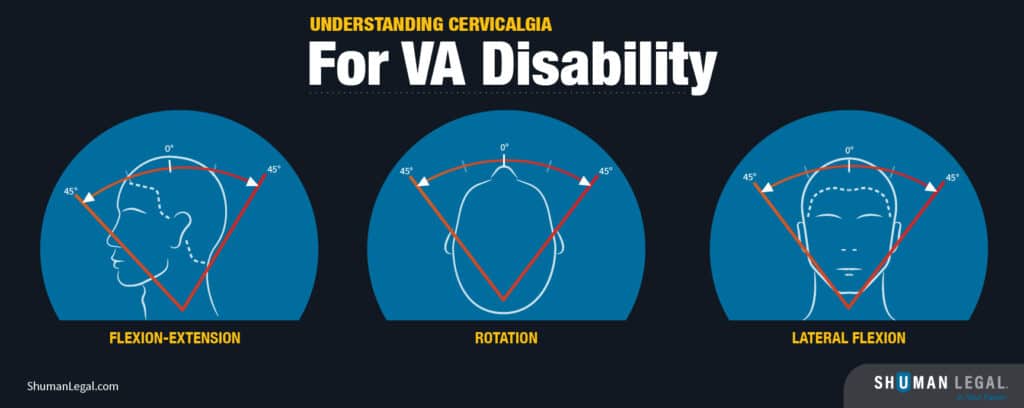
Range of motion evaluations are critical in the determination of VA disability ratings for neck pain. Defined normal ranges of motion for VA purposes involve accurate assessments of:
- Forward flexion
- Extension
- Lateral flexion
- Rotation of the head
A goniometer is recommended for the accurate measurement of range of motion at the C&P exam, and each reading should be rounded to the nearest 5 degrees for evaluation.
The extent of mobility restriction measured during the exam will be a major factor in the VA disability rating for neck pain awarded to the veteran. Any pain experienced by the veteran during range of motion testing can be used to aid in the VA rating for cervicalgia.
Secondary Conditions Associated With Neck Pain
In addition to the primary conditions associated with neck pain, there are other secondary conditions that can affect a veteran’s VA disability rating. Migraines and radiculopathy are examples of secondary conditions associated with neck pain. If properly documented, these conditions can increase a veteran’s VA disability rating. There are many secondary conditions that can affect a veteran’s VA disability rating for neck pain, some of which may include limitations on walking, difficulties in eating, and difficulties with swallowing.
Radiculopathy
Radiculopathy is one of the most common secondary disabilities associated with neck pain, often associated with cervicalgia. Therefore, it is recommended that veterans seek medical attention for a proper diagnosis and treatment plan. Radiculopathy can cause problems with the:
- Neck
- Shoulders
- Arms
- Hands
Nerve compression throughout the entire spine, especially in the cervical spine, typically causes radiculopathy. Radiculopathy is usually caused by cervical bone spurs and muscle spasms.
Veterans may be able to receive a VA rating for radiculopathy as a secondary claim to their VA disability claim for neck, shoulder, and back injuries.
Degenerative Disc Disease
Degenerative disc disease is another common condition associated with cervicalgia. Excessive activity during military service can accelerate the rate of neck wear and tear, causing degenerative disc disease. Symptoms of degenerative disc disease may include:
- Back pain
- Muscle weakness
- Pinching of nerves
- Symptoms that worsen with movement but improve when the veteran walks or changes position
The VA uses VA Disability Ratings to assess degenerative disc disease, which vary from 10% to 100% based upon the frequency, intensity, and duration of symptoms.
C&P Exam for Neck Pain
A Compensation and Pension (C&P) exam is a review of the veteran’s neck pain to determine whether it is connected to an in-service event. The C&P exam consists of the examiner asking the veteran about his/her condition and physically examining the veteran to assess the extent of the veteran’s neck pain.
During the C&P exam, the veteran’s range of motion is tested, and the veteran is asked to identify areas of the body where he/she experiences pain to assess the extent of the condition.
Preparing for the C&P Exam
Prior to attending the C&P exam, veterans should collect all medical documents related to their neck pain, including any additional conditions they may have developed. Compiling comprehensive medical evidence, such as VA and non-VA treatment records, diagnostic tests, and the opinions of medical professionals, will help support the veteran’s cervicalgia VA claim.
Veterans are encouraged to prepare themselves to discuss when their neck pain began, what effect it has had on their daily routine, and any secondary health issues that have occurred.
Interpreting the Examiner’s Opinion
The examiner’s opinion during the C&P exam can greatly affect the final determination of the veteran’s claim, and therefore, the VA rating assigned to the veteran’s cervicalgia. The VA typically disregards opinions from the C&P examiners who fail to adequately justify their conclusions; therefore, it is very important that the examiner provides a clear justification for the conclusions reached in the report.
As part of the C&P exam, the C&P examiners, as well as independent providers, are required to take into consideration and assign significant weight to the veteran’s reported symptoms while conducting the physical examination for the veteran’s neck conditions.
Your Search for Help Ends Here.
Get FREE Legal Advice Now!
An experienced Veteran Disability Appeals Attorney knows what needs to be done. The minute you sign with Shuman Legal® – we start working.
Denying a Claim and Appealing
If a veteran receives a low rating or a denial of their neck pain VA disability claim, they have the option to appeal. Veterans have 12 months to file an appeal after receiving the decision or file a supplemental claim. An appeal can result in the veteran being awarded VA benefits, including retroactive benefits, so it is worth it for veterans to attempt to appeal a decision they feel was unfair.
Reasons Claims are Denied
Claims for cervicalgia-related conditions are commonly denied because of insufficient service connection and a lack of formal diagnosis. When a veteran’s claim is denied, they may wish to seek out the services of an attorney to assist them in navigating the VA disability rating system and potentially overturn the denial of their claim.
Steps to File an Appeal
There are three options available to veterans to file an appeal for a denied claim: Supplemental Claim, Higher-Level Review, or Board Appeal. Each option has unique requirements and processes that veterans should be familiar with in order to make an educated decision.
Maximizing Your Cervicalgia VA Rating
Several steps can be taken to maximize a veteran’s cervicalgia VA rating. Establishing the degree of functional impairment and level of interference with the veteran’s ability to perform daily tasks caused by the neck pain is critical to the success of the veteran’s VA claim. Veterans can consult with attorneys who specialize in Social Security, workers’ compensation, and/or negligence cases to obtain recommendations for private medical experts who are knowledgeable in treating veterans with neck pain and spinal disorders, and who are experienced in filing VA claims.
In addition, documenting the secondary conditions associated with cervicalgia can help to maximize a veteran’s VA disability rating.
Obtaining Expert Opinions
Expert opinions obtained from qualified medical professionals can greatly enhance a VA claim by providing authoritative evidence of the service connection and severity of the veteran’s cervicalgia. Veterans should seek opinions from experts who specialize in neck pain and spinal disorders and have experience filing VA claims to ensure that the expert’s opinion is well-informed and relevant.
Documenting Secondary Conditions
Documenting secondary conditions is a key factor in strengthening a veteran’s VA disability claim for cervicalgia. Secondary conditions that veterans may want to document, such as depression, are commonly found among veterans who suffer from chronic conditions, such as cervicalgia.
Frequently Asked Questions
How much range of motion is needed for a VA Disability Rating for the neck?
The amount of range of motion necessary to receive a VA Disability Rating for the neck varies from 10% to 100%. A 10% disability rating is achieved with a range of motion of 30 to 45 degrees of flexion, or 175 to 340 degrees of combined range of motion. A 20% disability rating is achieved with a range of motion of 15 to 35 degrees of flexion, or 0 to 170 degrees of combined range of motion.
What is the Highest VA Disability Rating for Neck Pain?
Depending on the amount of limitation in the range of motion and the severity of the condition, including any resulting functional loss due to painful motion, the highest VA Disability Rating for neck pain is 100%.
Is Cervicalgia Considered a Disability?
Yes, Cervicalgia is a disability, and if the symptoms of the condition are severe enough and meet the specific requirements outlined by Social Security Listing 1.15(C), veterans may be eligible for SSDI or SSI Benefits. To be eligible for these programs, veterans must provide adequate documentation of their symptoms.
What is the VA Rating Code for Cervicalgia?
The VA Rating Code for cervicalgia is 5237. The code 5237 represents the diagnostic code for cervical strain and is used to determine the disability rating for cervical strain.
How Is Cervicalgia Related to Veterans?
Veterans are at an increased risk of developing cervicalgia, a condition that is characterized by chronic neck pain, because of the physical demands of military service, which often results in injury and strain to the neck and spinal cord. As a result of the strain to the neck and spinal cord, veterans may develop either acute pain as a result of injury or develop neck pain over time as a result of a disease.