

After a serious commercial vehicle crash, a Joliet truck accident lawyer can investigate who caused the collision, identify the companies involved, and protect evidence that may support your claim. Shuman Legal represents people injured in truck accidents throughout Joliet and Will County. Because trucking records and electronic data may be controlled by several different businesses, it is important to begin the investigation as soon as possible.
Hurt in a Semi-Truck Accident? You Need to Watch This…
Discover the myths of semi-truck accidents, and how we can help you navigate through them if you’ve been in a semi-truck accident.
When Can You Bring a Truck Accident Claim in Joliet?
You may have a truck accident claim when a driver, motor carrier, or another party acted negligently and that conduct caused your injuries. A successful claim generally requires evidence showing that the responsible party owed you a duty of care, failed to act reasonably, caused the collision, and left you with measurable losses.
A driver does not have to be the only responsible party. Depending on what happened, the motor carrier, truck owner, maintenance provider, cargo loader, or another business may share responsibility.
Passengers, pedestrians, bicyclists, and other motorists may bring claims when they are injured because of a truck crash. When an accident is fatal, the deceased person’s personal representative may bring a wrongful death action for the benefit of the surviving spouse and next of kin under the Illinois Wrongful Death Act.
Illinois also allows some injured people to recover compensation even if they share part of the blame. Under the state’s modified comparative fault law, recovery is barred only when the injured person is more than 50 percent responsible. If the person is 50 percent or less responsible, compensation is reduced according to that percentage of fault.
For example, someone who is found 20 percent responsible for a crash could recover 80 percent of their proven damages.
Your Search for Help Ends Here.
Get FREE Legal Advice Now!


An experienced Joliet truck accident lawyer knows what needs to be done. The minute you sign with Shuman Legal® – we start working.
What Should You Do After a Truck Accident in Joliet?
Your first priorities should be safety and medical care. Call 911, move away from traffic if you can do so safely, and accept medical attention when it is needed. Some injuries are not immediately obvious, especially when adrenaline is masking pain.
If conditions allow, collect information that is specific to the commercial vehicle. Useful details can include:
- The USDOT number displayed on the truck
- The name shown on the cab and trailer
- License plate numbers for the tractor and trailer
- Cargo or hazardous material placards
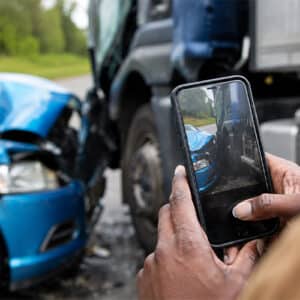
- Photographs of vehicle damage, skid marks, debris, lane markings, and road conditions
- Names and contact information for witnesses
- The locations of nearby traffic, business, or residential cameras
Preserve your own vehicle until the need for an inspection has been considered. Save photographs, videos, dashcam recordings, messages, and location information. Do not repair or dispose of important physical evidence without first documenting it.
You should also determine which agency investigated the collision. Joliet Police may handle crashes on municipal roads, while Illinois State Police often investigates interstate crashes. The “Investigated By” box on the report should identify the correct agency.
Joliet Police directs people to BuyCrash for copies of its crash reports.
Joliet Police crash report information: Illinois State Police has a separate process for reports involving crashes it investigated.
Illinois State Police crash report information
Notify your own insurer promptly, but be careful about speculating over fault or the extent of your injuries. You are not required to treat an adjuster for the trucking company as your adviser. Before giving that insurer a detailed recorded statement or signing a release, make sure you understand what is being requested and how it could affect your claim.
Why Joliet Truck Crashes Require a Different Investigation
 Joliet is part of one of the country’s busiest freight regions. Interstate 80 runs through Joliet and connects with Interstate 55 near major warehouse and intermodal operations. According to the Illinois Department of Transportation, the I-80 corridor through Joliet and Will County carries approximately 80,000 vehicles each day, and about 25 percent of them are trucks.
IDOT I-80 corridor information
That volume does not prove that a truck driver or company was responsible for a particular collision. It does explain why Joliet motorists regularly share roads with tractor-trailers, delivery vehicles, dump trucks, and other commercial vehicles.
A truck accident investigation can also involve relationships that do not exist in an ordinary car crash. The driver may work for one company while the tractor, trailer, and cargo belong to others. A separate business may have inspected the brakes, loaded the trailer, planned the route, or dispatched the driver.
Federal motor carrier regulations may govern driver qualifications, driving time, vehicle maintenance, inspections, and cargo securement. Whether a particular federal rule applies depends on the vehicle, cargo, operation, and carrier. Illinois traffic and negligence laws may apply alongside those federal requirements.
Who May Be Responsible for a Joliet Truck Accident?
Identifying every potentially responsible party is important because the company name painted on the truck may tell only part of the story.
The truck driver may be responsible for speeding, distracted driving, unsafe lane changes, following too closely, or driving while fatigued or impaired.
The motor carrier may be responsible for its own conduct, such as negligent hiring, inadequate supervision, unsafe scheduling, poor maintenance, or allowing an unqualified driver to operate a commercial vehicle. A carrier may also be legally responsible for a driver’s conduct under applicable agency and employment principles. Illinois law can limit certain separate negligent hiring, retention, or entrustment claims if the employer admits that it is legally responsible for the driver’s conduct.
The tractor or trailer owner may be responsible when a mechanical condition or failure to maintain the equipment contributes to the collision.
A maintenance company may bear responsibility if careless inspection or repair work leads to a tire, brake, steering, or lighting failure.
A cargo loading company may be responsible when an improperly balanced or unsecured load shifts, spills, or makes the truck difficult to control.
A manufacturer may be responsible when a defective truck component contributes to the crash.
A shipper or freight broker is not automatically responsible simply because it arranged the load. Claims against freight brokers require particular care because federal law may preempt certain state-law claims. In Ye v. GlobalTranz Enterprises, Inc., the Seventh Circuit held that an Illinois negligent-hiring claim against a freight broker was federally preempted. Whether you have another viable claim against a broker or shipper depends on the specific facts and legal theory involved.
Documents such as leases, dispatch records, bills of lading, maintenance agreements, and insurance filings can help clarify these roles.
What Evidence Can Prove What Happened?
Truck accident claims often turn on information that the injured person cannot obtain at the scene. Some evidence belongs to the carrier, while other records may be held by law enforcement, technology vendors, repair companies, medical providers, or nearby businesses.
Important evidence may include:
- Crash reports and scene records: The police report may identify drivers, witnesses, citations, road conditions, and an initial account of the collision. Emergency call recordings and officer video may provide additional context.
- Electronic logging records: These records can show a driver’s reported driving and rest periods. Supporting documents may include fuel receipts, toll records, dispatch messages, and location information.
- Truck data: When the vehicle is equipped with the relevant systems, engine control data, event information, telematics, and dashcam footage may show speed, braking, steering inputs, or the truck’s movement before impact.
- Driver qualification records: A driver’s employment application, license history, medical certification, training records, safety history, and annual reviews may reveal whether the carrier followed applicable qualification requirements.
- Maintenance and inspection records: Repair orders, inspection reports, tire records, and brake service documents can help determine whether a mechanical problem was known or should have been discovered.
- Dispatch and cargo records: Communications, route instructions, delivery deadlines, bills of lading, weight tickets, and loading documents may show who controlled the trip and how the cargo was handled.
- Drug and alcohol testing records: Federal rules require testing after certain commercial vehicle accidents, depending on the circumstances. Records can show whether testing was required, completed, and properly documented.
- Video and witness evidence: Nearby business cameras, residential cameras, toll facilities, dashcams, and witness accounts may capture information that is not available from the vehicles themselves.
- Physical and medical evidence: The condition of the vehicles can help explain the mechanics of the crash. Medical records can help document your injuries, treatment, limitations, future care needs, and the relationship between your condition and the collision.
Retention periods vary. When federal hours-of-service recordkeeping rules apply, motor carriers generally must retain required records of duty status and supporting documents for at least six months.
Federal hours of service record rule: Motor carriers subject to the federal rule generally must keep an accident register for three years for crashes that meet the federal definition of an ‘accident.’
Federal accident register rule
Other electronic data may be overwritten much sooner under a company’s normal practices. Prompt preservation requests can identify the records that should be retained while the claim is investigated.
Your Search for Help Ends Here.
Get FREE Legal Advice Now!
An experienced Joliet truck accident lawyer knows what needs to be done. The minute you sign with Shuman Legal® – we start working.
How Shuman Legal Investigates a Joliet Truck Crash
A useful investigation begins by identifying the people and businesses involved. It should not assume the driver is the only responsible party or that the company displayed on the trailer operated the truck.
When Shuman Legal reviews a Joliet truck accident, our work may include:
- Reviewing the crash report, photographs, witness information, and medical records
- Identifying the motor carrier, driver, tractor owner, trailer owner, cargo interests, and insurers
- Sending preservation requests to the parties that control relevant records
- Obtaining carrier, maintenance, inspection, employment, and dispatch documents
- Arranging vehicle inspections and consulting qualified professionals when the facts call for them
- Evaluating how the injuries affect medical needs, work, family responsibilities, and daily life
- Presenting the claim to the insurers and preparing for litigation when a reasonable resolution cannot be reached
Not every case requires the same experts or records. The investigation should be based on the facts of the collision, not a standard checklist applied without thought.
For more general information about trucking claims, visit our page about commercial truck accident claims in Illinois.
What Compensation May Be Available?
Compensation depends on the evidence, the available insurance or other sources of recovery, the seriousness of the injuries, and the effect the crash has had on the person’s life.
Recoverable losses may include:
- Emergency treatment and hospital expenses
- Surgery, rehabilitation, medication, and future medical care
- Lost wages and reduced earning capacity
- Vehicle damage and other documented expenses
- Physical pain and emotional suffering
- Disability, disfigurement, and loss of normal life
A settlement should account for more than the bills that have already arrived. Serious injuries may require future treatment or prevent someone from returning to the same occupation. Medical opinions, employment records, and vocational evidence may be needed to document those losses.
When a crash is fatal, Illinois law may permit a wrongful death claim for the surviving spouse and next of kin. A separate survival claim may preserve certain claims the deceased person could have pursued if they had lived.
There is no dependable average settlement for a Joliet truck accident. Each result depends on its own facts, injuries, evidence, defendants, insurance, and disputed issues.
How Long Do You Have to Act?
Illinois generally requires a personal injury lawsuit to be filed within two years after the claim accrues.
Illinois personal injury filing law.
A claim limited to damage to personal property generally has a five-year filing period.
Illinois property damage filing law
Different rules can apply when a local public entity or employee is involved. Some actions against a local public entity must be filed within one year.
Illinois Local Governmental and Governmental Employees Tort Immunity Act
Other exceptions may change the deadline. The correct period depends on the defendants, the nature of the claim, and the circumstances of the injured person.
The filing deadline is also different from the practical deadline for preserving evidence. Waiting two years to investigate could allow useful video, electronic information, physical evidence, or witness memories to disappear even if the lawsuit itself is still timely.
Why Choose Shuman Legal for a Joliet Truck Accident Case?
Shuman Legal has represented more than 25,000 injured people throughout Illinois since 1996. We also maintain a Joliet office, giving local clients a place to discuss their cases without traveling into Chicago.
Truck accident cases require careful attention to corporate relationships, technical records, insurance coverage, and long-term medical needs. Our role is to determine what happened, explain the available options in plain language, and take the legal work off the client’s shoulders.
We handle personal injury cases on a contingency fee basis. That means clients do not pay an attorney fee unless we recover compensation for them. The written fee agreement explains the percentage and how case expenses are handled.
Past outcomes cannot promise what will happen in a new case. What we can offer is a careful review of the facts and an honest discussion about whether we believe a claim can be pursued.
Speak With a Joliet Truck Accident Lawyer
If you were injured in a commercial truck crash, Shuman Legal can review what happened and explain your options. Our Joliet office is located at 1000 Essington Road, Suite 126, Joliet, Illinois 60435.
Contact us to speak with a Joliet truck accident lawyer. The consultation is free, and there is no attorney fee unless we recover compensation for you.