

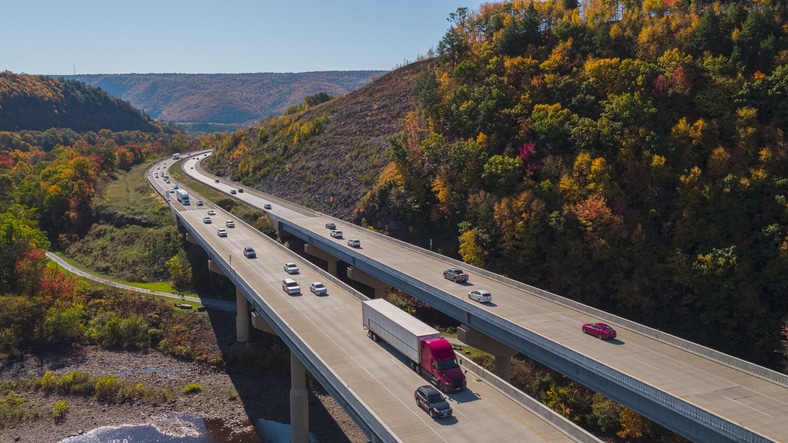
Entender las diferencias entre el transporte por carretera interestatal y el intraestatal puede parecer complicado, pero no es tan confuso como parece.
Su búsqueda de ayuda termina aquí.
Obtenga asesoría legal GRATIS ahora
 Programar consulta
 Llame ahora
En el momento en que firma con Shuman Legal®, comenzamos a trabajar
En pocas palabras, esta es la diferencia:
Las empresas de transporte por carretera interestatal transportan mercancías a través de las fronteras estatales y nacionales. Estas empresas de transporte deben registrarse ante el Ministerio Federal de Transporte y cumplir con las leyes y normativas de la Asociación Federal de Seguridad de Transportistas por Carretera (FMCSA).
Las empresas de transporte por carretera intraestatal transportan mercancías dentro del mismo estado en el que empiezan. Se rigen por las leyes de cada estado.
Por desgracia, los accidentes de camión ocurren tanto con vehículos comerciales interestatales como intraestatales. Como los casos legales por accidentes de camión son un tipo de demanda muy específico, es importante buscar un abogado que haya llevado varios casos similares en el pasado.
Un abogado que te represente tiene que tener los conocimientos y los recursos necesarios para llevar casos de responsabilidad civil contra grandes empresas de transporte, fabricantes de camiones y compañías de seguros comerciales, por citar algunos ejemplos. También debe saber cómo varían las leyes según si el camión circula por rutas interestatales o intraestatales y, en el caso de las rutas intraestatales, conocer las leyes del estado donde ocurrió el accidente.
Si te ves envuelto en un accidente con un camión de transporte, podemos ayudarte a gestionar todo el proceso. Te ofrecemos mucha información, a la que puedes acceder fácilmente y en cuestión de minutos desde nuestra página web. O también puedes llamarnos para recibir asesoramiento jurídico gratuito sobre tu caso.
Artículos relacionados
¿Qué es un accidente de camión con pliegue en V?
Ejemplos de camiones de transporte interestatal
Hay muchos ejemplos de empresas de transporte por carretera que operan a nivel interestatal, transportando cargas a través de más de un estado o país. Estos camiones suelen ser más grandes porque transportan cargas más voluminosas y pesadas.
Algunos ejemplos de camiones típicos para el transporte interestatal son:
- Camión con remolque: vehículo de transporte compuesto por un semirremolque y un remolque acoplado
- Camión de 18 ruedas: la combinación de un tractor y uno o más semirremolques para transportar mercancías, que suele tener 18 ruedas
- Semirremolques y camiones con semirremolque: la combinación de un tractor y uno o más semirremolques que se usa para transportar mercancías. El semirremolque se acopla al camión mediante un tipo de enganche llamado «quinta rueda».
- Los camiones frigoríficos, también conocidos como remolques frigoríficos, cuentan con varias piezas adicionales y aislamiento para mantener el camión frío, como un evaporador, un condensador, un compresor y el motor frigorífico acoplado al remolque que hace funcionar el sistema de climatización.
- Camiones de plataforma: el remolque acoplado tiene una plataforma plana sin laterales
- Furgonetas de carga seca: un tipo de semirremolque cerrado para proteger la carga de las inclemencias del tiempo, pero que no tiene control de temperatura como los camiones frigoríficos
- Camiones cisterna: se usan para transportar líquidos, como productos químicos, líquidos, gases, bebidas y mercancías secas, como cereales
Ejemplos de camiones que circulan dentro del mismo estado
No todos los vehículos comerciales tienen que cruzar las fronteras estatales. Muchos tipos de camiones que requieren permisos de conducir de alto nivel operan cerca de casa.
Algunos ejemplos de camiones que circulan dentro de un mismo estado son:
- Vehículos de mudanzas: cualquier vehículo que se utilice para el transporte de enseres domésticos, material de oficina y mercancías especiales en el comercio intraestatal
- Camiones de la basura: se usan para recoger la basura y los residuos que la gente deja fuera de sus casas, negocios, etc.
- Grúas: se usan para retirar vehículos averiados, inmovilizados, aparcados ilegalmente, incautados o que se encuentren en cualquier otra situación que impida su uso.
- Camiones volquete: se usan para transportar materiales como arena, grava o escombros de demolición hacia o desde las obras de construcción
- Camiones de reparto: un camión o furgoneta diseñada para repartir productos a los clientes
- Camiones hormigonera: un camión que transporta materiales de hormigón, ya sean secos o húmedos, para mezclar y verter el hormigón en las obras.
- Furgonetas – Un camión con un compartimento de carga independiente con forma de caja
- Carretillas elevadoras con cubeta: una carretilla multiusos que utiliza una pluma hidráulica con un accesorio de cubeta para elevar a una persona de forma segura y que pueda llegar a zonas altas
Su búsqueda de ayuda termina aquí.
¡Obtenga asesoría legal GRATIS ahora!
Un abogado con experiencia Abogado especializado en accidentes por conducción distraída sabe lo que se debe hacer. En el momento en que firma con Shuman Legal®, comenzamos a trabajar.
¿Por qué sería importante saber la diferencia?
Es importante saber que hay normativas diferentes para las empresas de transporte por carretera interestatales y las intraestatales. Las leyes que regulan una empresa de transporte, a los conductores de camión y al propio camión son diferentes para los conductores de semirremolque que cruzan fronteras estatales en comparación con los que operan dentro de un mismo estado.
Las empresas de transporte por carretera interestatal se rigen por las normas de la Agencia Federal de Seguridad de Transportistas Motorizados (FMCSA). La misión principal de la FMCSA es reducir los accidentes, las lesiones y las muertes en las que se ven implicados vehículos comerciales de gran tamaño. Las normas de la FMCSA tienen prioridad cuando un camión transporta carga por más de un estado, lo que proporciona un conjunto de normas reguladas que hay que seguir, en lugar de tener que conocer las leyes de cada estado por el que se circula.
Las empresas de transporte por carretera intraestatal se rigen por las leyes de cada estado, y esas leyes y normativas varían de un estado a otro. A menudo, las leyes y normativas estatales son similares a las de la FMCSA, pero pueden presentar diferencias importantes.
¿En qué se parecen el transporte interestatal y el intraestatal?
Aunque la normativa es diferente para los conductores comerciales que hacen rutas interestatales y los que hacen rutas intraestatales, hay algunos aspectos en los que se parecen. Al fin y al cabo, el objetivo de crear estas leyes y normativas siempre ha sido garantizar unos procedimientos de conducción seguros. Algunos requisitos son los mismos para todos, tanto en las operaciones interestatales como en las intraestatales, independientemente de dónde opere el camión.
Entre los requisitos que deben cumplir todas las empresas de transporte por carretera se incluyen:
• Requisitos para el carné de conducir profesional (CDL)
• Cobertura de seguro para camiones comerciales
• Pruebas de detección de drogas y alcohol
• Transporte de materiales peligrosos
• Requisitos para los conductores